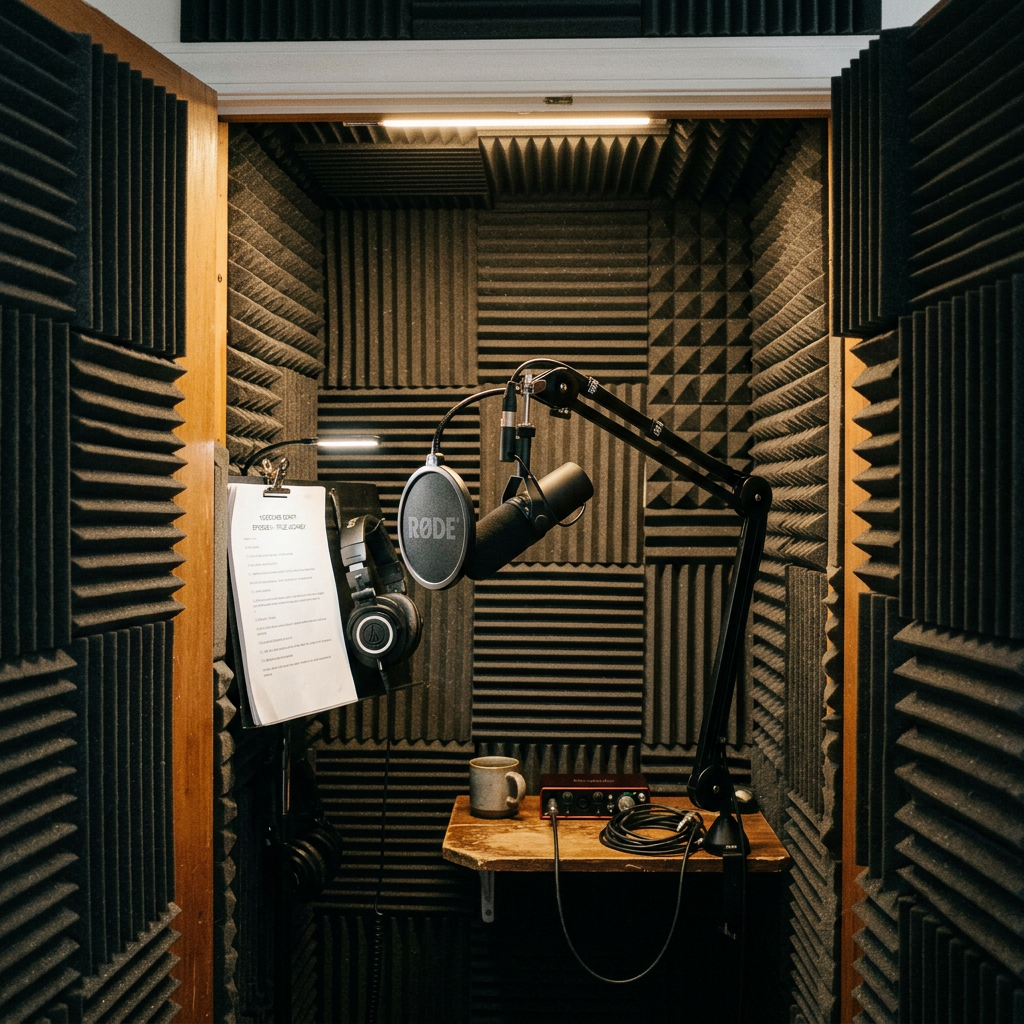
How a closet, a microphone, and a series of small improvements became a professional voiceover workspace.
When people hear the words home voiceover studio, they may picture an elaborate room filled with expensive equipment, glowing control panels, and enough acoustic foam to make the walls look like a futuristic waffle.
Mine began with a closet.
That may not sound glamorous, but voiceover is not really about how impressive a studio looks. It is about what the listener hears—or, more importantly, what they do not hear.
No air-conditioning rumble. No computer fan. No hollow room reflections. No traffic outside. Just a clean, clear voice that a client can confidently place into a commercial, training program, explainer video, audiobook, or other production.
Building my home studio has been a gradual process of learning what matters, solving one problem at a time, and resisting the temptation to believe that the next piece of equipment will magically fix everything.
The room matters more than the microphone
One of the first lessons most voice actors learn is that an expensive microphone cannot rescue a poor recording environment.
A sensitive condenser microphone hears much more than a voice. It also hears reflections bouncing off walls, nearby electronics, air moving through vents, footsteps elsewhere in the house, and sounds you might not notice until you put on headphones.
That is why my recording space became a treated closet-style booth.
Clothing, acoustic blankets, foam, and other soft materials help absorb sound before it reflects back into the microphone. The goal is not to make the booth completely silent—that would be difficult in almost any home—but to create a controlled environment where my voice sounds natural, close, and consistent.
The booth has evolved as I have learned more. Some changes were substantial. Others were small adjustments to microphone placement, acoustic treatment, or how I positioned myself while recording.
Every improvement began with listening.
Moving the computer out of the booth
One of the most valuable upgrades did not involve purchasing a new microphone or audio interface.
I moved the computer and workstation outside the recording booth.
Computers generate heat, and heat activates fans. Fans create noise. Monitors and desks also introduce hard reflective surfaces that can affect the sound inside a small recording space.
Removing those items reduced the noise floor and eliminated several surfaces that could reflect sound toward the microphone. It also made the booth feel more like a dedicated performance space instead of a tiny office that happened to contain acoustic treatment.
My workstation now sits outside the booth, while the microphone and recording area remain inside. That separation gives me a quieter recording environment without sacrificing access to my scripts, controls, and recording software.
It also makes the booth a more focused space. When I step inside, my job is no longer to operate a computer. My job is to communicate.
The equipment behind the voice
My primary voiceover microphone is a RØDE NT1 Signature Series, connected through a RØDECaster Duo audio interface. I record and edit in REAPER, a digital audio workstation that provides the flexibility I need for recording, cleanup, editing, and delivery.
Each part of that chain has a purpose.
The microphone captures the performance. The interface converts it into a high-quality digital signal. REAPER gives me the tools to edit mistakes, manage levels, reduce unwanted noise when necessary, and prepare audio according to a client’s technical requirements.
However, none of that equipment replaces the fundamentals:
- Consistent microphone technique
- Proper recording levels
- A controlled acoustic space
- Careful listening
- Clean editing
- An engaging performance
The technology should support the message rather than call attention to itself.
That idea fits naturally with the work I want to do: helping complex information sound clear, credible, and human.
A studio is also a workflow
A professional home studio is not only a collection of equipment. It is a repeatable system.
When a project arrives, I need to be able to review the script, record efficiently, make revisions, export the correct file format, and deliver clean audio without turning every assignment into a new technical experiment.
That has meant developing a consistent workflow in REAPER, organizing project files carefully, creating reliable recording and processing settings, and learning how to meet different specifications.
A commercial may have different delivery needs than an audiobook. An eLearning project may involve many separate files with strict naming conventions. A remote-directed session requires dependable communication and routing. Each project brings its own details, but the underlying system should remain stable.
My background in technology and business systems probably makes me especially interested in this side of the work. I enjoy the performance, but I also enjoy designing a process that makes the performance easier to capture and deliver.
A good workflow helps me remain focused on the script instead of wrestling with the machinery.
The studio will never really be finished
There is always another possible improvement.
A quieter cable arrangement. A better monitor position. Another layer of acoustic treatment. A more efficient editing shortcut. A new way to organize sessions.
That does not mean the studio is inadequate. It means that building a studio is an ongoing practice in observation and refinement.
The danger is believing that professional work can only begin once everything is perfect.
It cannot.
At some point, the microphone has to be turned on. The script has to be read. The work has to leave the booth and reach another human being.
My studio is professional because it allows me to deliver clean, reliable audio—but it is also personal. It reflects years of interest in technology, music, production, communication, and sound. Those different threads now meet in one small room where the objective is surprisingly simple:
Help the message land.
That is what the booth is ultimately for.
Not to showcase equipment.
Not to create the most impressive background for a photograph.
To create a quiet space where a voice can connect with someone listening somewhere else.
And sometimes, that really does begin in a closet.

Leave a Reply